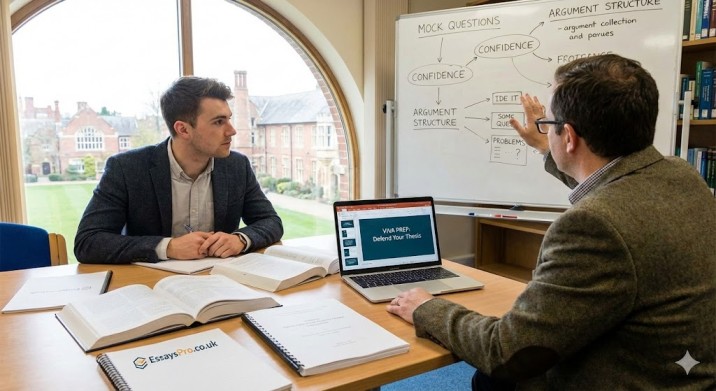
A Viva preparation guide
Although getting ready for the viva always seems challenging, it actually demonstrates the student’s level of expertise in their field. In the UK, there are typically two examiners, one from your own university and another from a different university, who are interested in learning about the narrative aspects of your work. They want you to succeed in your field and realize your academic potential, not to make your preparation challenging. This guide will explain common questions and their answers, help you prepare for the viva, and demonstrate how to defend your thesis professionally.
Understanding the Procedure
This is an oral examination of your written thesis. There are usually two examiners, one internal and one external. Your supervisor may also be present if you wish, but they will not ask questions. Sometimes there are more examiners in different disciplines than in the viva. The viva is essentially a defense of your research. You have to convince the examiners that your work is your own, well-researched, and makes a significant contribution to your field.
In practice, you will be expected to present a complete knowledge of your field, defend your thesis, and explain your methods and findings. Examiners will ask questions on every aspect of your thesis, usually starting with general questions first and then moving on to each chapter or topic. They may also ask you to refer to a specific page of the thesis, so it is important that the version you have matches theirs.
Before Viva Preparation Steps
A strong thesis is your best preparation. Proofread it carefully, paying attention to the citations, grammar, and formatting. A well-edited, error-free manuscript is less likely to receive criticism, according to one guide. To identify errors, read it aloud to yourself or a coworker. Adhere strictly to the formatting guidelines set forth by your university (fonts, margins, referencing style, etc.). First, familiarize yourself with the viva requirements of your institution. Find out who will be there (chair, supervisor, and examiners) and what their responsibilities are. Verify submission deadlines and additional logistical information. To get a sense of what to expect, read the graduate handbook or any other available guide. Particularly, the external examiner, who is typically a subject-matter expert. Reading the examiners’ recent work helps you understand their interests and likely questions. Your supervisor can also guide you on topics they may focus on. Summarize each chapter in one clear sentence to capture its main ideas. When you review your thesis, note any weak points or gaps. Be prepared to discuss them: examiners will notice problems, so it is best to point them out yourself. Write down how you can improve these weaknesses or why certain decisions were made.
Most importantly, remember the strengths and originality of your work know what your research adds to the collection of information. Examiners are happy to hear that your thesis is valuable and important.
Since the viva is an oral exam, practice talking about your research out loud. Try to give a short 5–10 minute overview of your thesis and key findings. This can often be asked as the first question. Practice explaining your objectives, methodology, and results in simple terms. You don’t need to memorize the answers, but explaining them repeatedly will help you speak more confidently and fluently. Make a list of possible questions. Include common questions, and especially those that you find difficult. Write bullet points for the answers to the difficult questions. This way, mental practice will make even those “nightmare” questions manageable.
Practicing the Viva Skills
It’s not enough to just know your answers; practice saying them out loud. Work on your confidence and pace. Record yourself or present at a departmental seminar. As one recent graduate said, By the time you finish your PhD, you know your thesis well, but you don’t have as much practice explaining it verbally. Take the time to explain the main points.
Length of answer: Be prepared to give short answers and sometimes detailed answers. Practice summarizing your main arguments in a sentence or two (for quick questions) and sometimes elaborating (for follow-up questions).
Take advantage of Q&A: Regard each question as an opportunity to show off your work, not a trap. If the question is general, use it to restate your main hypotheses or findings. If the question is narrow, give a short answer and then connect it to your bigger picture.
Stay up to date with your field: Keep up to date with the latest information in your field during your preparation. If there is any new relevant research or method that has come out since your submission, read about it. You may be asked how your work fits into new trends.
Relaxation and stress reduction techniques: Use stress reduction techniques. Take deep breaths or take short breaks before practicing. During the viva, if you get nervous, write down notes to take your time or say, “That’s a good question, I need a moment to think.” Pausing for a moment or drinking water can also help you sort out your thoughts.
Common Viva Questions and Answers
Examiners often ask questions in certain categories. Prepare concise answers to questions like these: General overview: Why did you choose this topic? How did you develop an interest in it? Or “Could you please summarise your thesis and its main contributions?” They might start with an “introduction” question (often asking for a 5–10 minute synopsis). Tip: Prepare a clear “elevator pitch” version of your research for this.
Research context: Who are the key people in your field? Or, what is the wider context, and why is this research important? Examiners want to know you understand how your work fits into the literature. Be able to name major authors and how they influenced you. Also, what developments have occurred in your field since you began?
Methodology: Why did you choose this research method? What were its advantages and limitations? Did you consider alternatives? Or, how did you analyze the data? Discuss your methods clearly: justify your choices and show you considered other options. If you used a specific technique, explain why it was the best fit and acknowledge any drawbacks.
Results and analysis: Did your results meet your expectations? If not, why? What problems did you encounter in data collection/analysis? Be prepared to explain your findings and any anomalies. If a different approach could yield different results, acknowledge it. Examiners often ask the so-what question: What is the significance of your findings? What are the implications for theory, practice, or future research? Be ready to discuss the impact of your work.
Original contribution: What do you consider to be the original contribution of your thesis? What are the most important findings? You should be able to articulate exactly what is novel about your work and why it advances knowledge. Write this down in a paragraph before the viva, knowing your contribution clearly is crucial.
Unanswered questions: If you had more time, what would you do next? What are the limitations of your study? It’s not a problem if you have future work ideas. The key is to show self-awareness: point out reasonable limitations and how you might address them. Examiners respect candidates who know how to improve their own work.
Plan for publication: Examiners occasionally inquire about dissemination. Where will this work be published? Prepare a response that includes specific journals or conferences. This demonstrates your creativity.
Advice for learning the answers during the Viva:
- Understand the question well: First, make sure that you understand what the examiner is asking. If you don’t understand the question, it’s perfectly fine to ask them again.
- Be direct: First, answer what has been asked briefly and accurately. Then, if necessary, add a little detail. Avoid unnecessary details.
- Structure your answer: A good method is: point, example, conclusion. That is, first tell your point, then give an example from your research or knowledge, and finally wrap up the fact.
- Be brief but complete: Avoid long sentences. If you feel like you are repeating yourself, it is better to stop and say, “Maybe I am repeating myself.”
- Confirm after the answer: You can answer by asking: “Is this answer correct?” This shows that you are polite and understand the question correctly.
- Be calm and professional: Speak slowly and clearly. If a question seems difficult, don’t panic; take a moment to think about it. If you really don’t know, politely say that you will think about the answer or make a guess based on your thesis.
- Defend, don’t apologize: Be confident in your research. Don’t point out your weaknesses. If there is a problem, talk about the positive side.
- Avoid memorized sentences: Don’t give prepared, rote answers. Speak naturally. Speak from understanding, not just from memory.
- Use your thesis: If you get stuck on a very technical or specific question, it’s okay to look at your thesis. Looking at your notes or the page for a moment or two refreshes your mind.
Some simple tips for the viva day
What to bring:
Bring a printed copy of your thesis (if necessary). You may also want to bring your important notes or a few important research papers. Some people also carry a small notebook or a list of prepared answers as a reminder. Keep water handy. Wear clean, comfortable clothes to feel confident.
Before you start:
It is perfectly normal to feel nervous while waiting. Take a few deep breaths. When called into the room, greet the examiners by name and thank them for reading your thesis. A small smile or handshake will make the atmosphere friendly.
During the viva:
Focus on one question at a time. If two or three questions are asked at the same time, answer them in order. Sit up straight and look at the person asking the question. Don’t keep your voice too soft; speak clearly and firmly.
Using your copy:
If allowed, put colored tabs in your thesis so you can quickly find them when you need them. Don’t search through your papers too frantically—examiners expect you to know your work well.
Time management:
There is usually no set time for each question, but the entire viva can take anywhere from 1 to 3 hours. Try to answer in full, but don’t go too long. If you feel like you’re getting carried away, you can ask if you can shorten it.
If you get stuck or lose your mind:
You can ask for a little more time or a short break. If a question seems too difficult, politely say that it’s a little outside my scope, but still give appropriate feedback based on the topic at hand.
Stay positive:
Don’t be alarmed if there is a brief silence. Most examinees don’t talk much at first, so you can start calmly. Silence doesn’t mean that something is wrong. Good preparation, practice, and confidence are the keys to a successful viva. Follow these tips and have a confident Viva day. Best wishes!
Written by Mahnoor Nadeem Ahmed