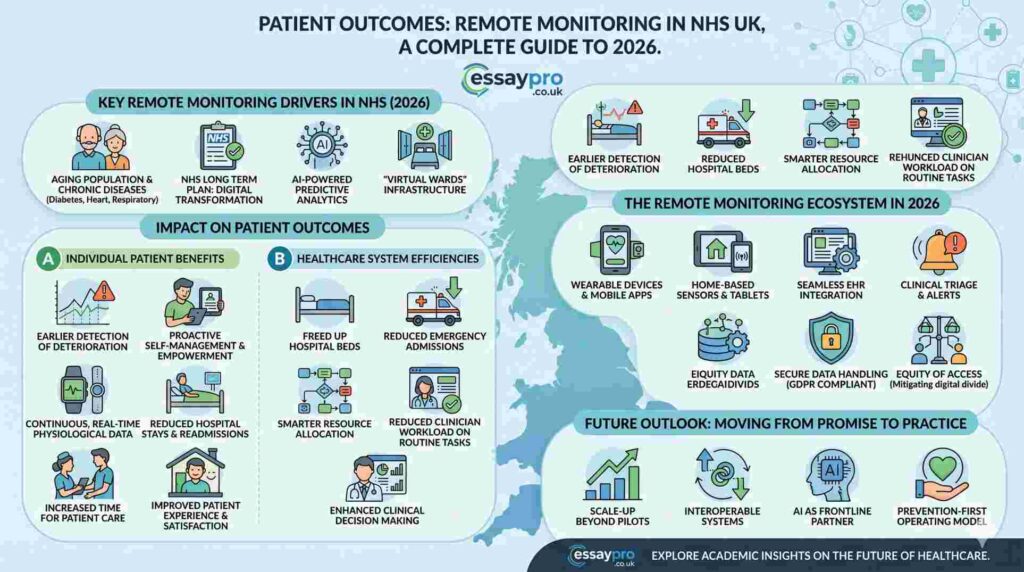
What are Patient Outcomes When they Experience Remote Monitoring in NHS UK: A complete guide to 2026
Introduction: A New Era of Digital Healthcare in the National Health Service
The role of digital innovations in the National Health Service in 2026 has significantly expanded. New innovations are emerging every day, and these innovations are making people’s lives easier. The remote monitoring system introduced in the NHS has not only made patients’ lives easier, but it has also provided a seamless experience for doctors. Now, patients no longer have to wait in long lines for their turn, but they can also get their check-ups done at home. This has proven to be a major revolutionary step for the UK’s National Health Service. The goal of remote monitoring is to provide hospital-like care at home and only serious cases should reach the hospital.
Overview of the Remote Monitoring System in NHS
There isn’t a single software used for remote monitoring in the NHS; instead, there are many different software used for different tasks. These software play a vital role in creating a remote monitoring environment. Here, I’ll share some commonly used and trusted software that are gaining widespread use.
This is a cloud-based telehealth platform specially designed for remote monitoring. With its help, patients can get their check-up done at home. Patients can check their BP, Oxygen or Temperature at home and send it to the doctors through this platform and doctors can monitor it in their hospital dashboard and suggest medicines to the patient. This saves both money and time and the patient’s care is just like in a hospital. It is being used a lot in the virtual wards of NHS.
This is also a very common RPM (Remote Patient Monitoring) which is being used a lot in NHS (National Health Service). This platform provides Hospital@Home solution especially for NHS. The patient checks his BP, oxygen, pulse rate, sugar rate at home and the result is sent to the doctor through SMS, phone call or data app. The nurse or doctor sees these results on the dashboard. If the reading is bad, an alert is sent and the patient is taken care of without admitting him to the hospital. If the condition is very bad, then early warning is also given through this.
Luscii is a platform that supports remote monitoring system. In NHS, Luscii supports remote monitoring in virtual wards. Through this platform, patients can submit their vital signs and early symptoms, which helps doctors to be aware of the patient’s condition and if any serious condition occurs, they also get help in taking action. Doctors are monitoring the patient’s condition through this platform and they get the opportunity to take quick action in case of serious condition.
Doccla is also a platform like Luscii which is used for remote monitoring of patients in virtual wards of NHS. But there is a small difference between these two platforms that through Doccla the patient is also provided with devices for home monitoring like BP and pulse oximeter. Patients can remotely submit their signs and symptoms to doctors. This way the doctors remain aware of their patient’s condition and it also helps in taking quick action in case of a serious condition.
In National Health Services UK, there is no single fixed software used for remote monitoring, there are multiple systems that are used which make the remote monitoring system very effective.
Simple Flow of NHS’s Virtual Wards
First, patients are given a home monitoring plan. They then undergo a check-up at home. Patients are given devices such as a blood pressure monitor, pulse oximeter, or thermometer. The patient takes their daily readings and sends a screenshot to the doctor or some devices automatically sends the readings. After that, the data is automatically sent to the dashboard of the remote monitoring platform.
The system stores all the readings and detects normal and abnormal values. After that, the nurse in NHS checks the dashboard. The nurse calls or messages the patient if the condition is mild and advises him on the doctor’s suggestion. The monitoring system generates an alert based on the patient’s condition. If the condition is normal, no action is taken, if there is a mild risk, the nurse calls and advises the patient on the doctor’s suggestion. If there is a high risk, an alert is sent to the doctor. Only critical and important alerts are shown to the doctors. The doctor reviews all the patient’s data, changes the treatment and then decides when the patient should be admitted to the hospital.
The purpose of remote monitoring is not just to provide relief to patients, but also to provide them with the best patient care. This system has not only benefited patients but also doctors and the healthcare department. This system has also reduced pressure on the healthcare system.
What Improvements have been made in the Development of Remote Monitoring System in NHS?
This concept of remote monitoring is actually a part of telemedicine and digital healthcare. Through technology, software and devices, the vital signs of the patient are measured and transferred to the clinic through a secure digital platform.
These devices are mostly used in chronic conditions like diabetes, heart disease, COPD or hypertension because their results are also obtained through a completely secure and digital technology. Earlier, patients had to go to the hospital for regular check-ups, which took a lot of time and cost a lot of money. Now, remote monitoring has given relief to all these things. People can track their health sitting at home and both time and money are saved. NHS started remote monitoring during the COVID-19 pandemic of 2020 and it was very important, like when the time of COVID ended, this remote monitoring is still a part of NHS and even today in 2026 it is a part of healthcare. In the pilot program, heart patients, patients after operations and disabled people have been given health tracker devices, through which their check-up can be done at home and they do not have to be admitted to the hospital again.
After Remote Monitoring, did the Condition of the Patients Improve or Not and what is its Result?
Remote monitoring has been of great benefit to patients. Those who were anxious to go to the hospital, or those who could not afford the expensive fees of doctors for check-ups, or those who were so busy with work that they did not have time for their health check-ups, the lives of all of them have become much easier. Now they get their check-ups done at home. Patient monitors their vital signs every day and sends them to doctors, due to which their health is tracked daily and they remain safe from any major illness and if the illness gets diagnosed in time, its treatment becomes possible. Research has also shown that remote monitoring significantly improves patients’ health. When patients can view their own data daily through devices and track their progress, the treatment process also improves. Pilot studies in the NHS have shown that hospitalization rates for heart failure patients using remote monitoring have decreased by 25-30%, and blood pressure and glucose levels have also been significantly controlled.
This technology has been of great benefit to the doctors as they do not have to do repeated check-ups of the same patients and due to this the pressure of daily routine vital collection on the doctors has also reduced to a great extent. Due to this a lot of time is saved and they can give more time to complex cases and can monitor them properly.
What are the Difficulties Faced in Remote Monitoring and what are the Restrictions that have to be met?
Earlier I told you that remote monitoring has a lot of advantages and now I will tell you that along with the advantages, what difficulties we have to face and what are the restrictions. The first challenge of all is the digital divide. Now not every patient has access to a smartphone, tablet or internet. That is why those urban patients who cannot afford these things face a lot of problems in getting better healthcare. The NHS is now launching a Devices and Connectivity support program, which is a great step that will ensure better healthcare for people who do not have access to digital technologies.
Another major issue is data security and privacy. Remote monitoring involves the constant transfer of sensitive patient health data, which must be protected through secure channels and encryption. Compromising data security can affect both patient trust and security agreements. The NHS is now developing robust cybersecurity frameworks to provide patients with assurance that their sensitive data is safe.
The third problem which is very common is patient engagement, that is, despite having the device, patients do not know how to use it properly. Merely providing devices does not improve patient outcome. Patients should also receive proper training on how to use them correctly so that the result is correct and accurate. Unless there is understanding, it will not be known whether the result is correct or not. If the patient does not accurately measure the results of the devices and does not send his progress to the doctor daily, then the doctor will not track his progress daily. Due to which the benefits of remote monitoring remain limited.
Case Study: Treatment of Heart Patients in the NHS Using Remote Monitoring
Let me tell you about a very famous case where heart patients are treated in the NHS using remote monitoring and it has been successful. A program was started in NHS through which heart patients were provided with devices through which patients checked their heart rate and oxygen level and sent the result to the doctor. Doctors kept seeing the result on their dashboard and remained aware of the health condition of the patients and gave suggestions to the patients. Due to this there has been a significant improvement in the recovery of patients and the hospital readmission rate has reduced by 28% in 12 months. Through this progress, not only the devices were given but they were also teaches to use them practically. Through this program, it became known that remote monitoring is not only about providing devices to the patients but also gives a complete guide on how this entire system works. All these things together create a good healthcare system due to which the health of the patients has improved a lot and the remote monitoring system has become very successful.
Impact of Remote Monitoring on Money and Work:
Remote monitoring saves the patient’s money and also reduces the burden on the doctor as the patient does not have to visit the hospital for frequent check-ups. Health economists have estimated that the NHS will have annual savings of £150-200 by 2026.
By 2027 and in the coming days, the remote monitoring system in the NHS will be much improved. Artificial intelligence will be used to diagnose the early signs of the patient. Artificial intelligence can also be used to diagnose chronic diseases in a timely manner. When a chronic disease is detected early, the chances of recovery are also improved. The use of lot sensors in the devices provided to patients will also improve the patient outcome. National health services policies are supporting this artificial intelligence system and may also implement this remote monitoring system in future.
Some Suggestions for Policy Makers:
Policy makers should take some important steps to ensure effective implementation of remote monitoring. First of all, it is important to ensure that every patient has access to devices and connectivity. Training programs for patients and clinicians are essential. Standardized KPIs and evolution frameworks should be developed to measure the results of remote monitoring.
Conclusion:
National Health Services UK is bringing significant improvements in patients’ healthcare through remote monitoring. This system collects real-time data from patients’ devices, which helps doctors stay aware of their every health condition and helps them take action in case of a critical condition, increasing the patient’s chances of recovery. Patent involvement is also very important to make healthcare effective. Every patent must have devices and connectivity access and patients must know how to use these devices.
The NHS is developing new rules and technologies to address these problems. In the future, the healthcare system will become more effective, faster, and cost-effective by using remote monitoring and AI.
This system is a good opportunity not only for working professionals but also for students to learn and apply.
Written By: Sidra Gillani🦋