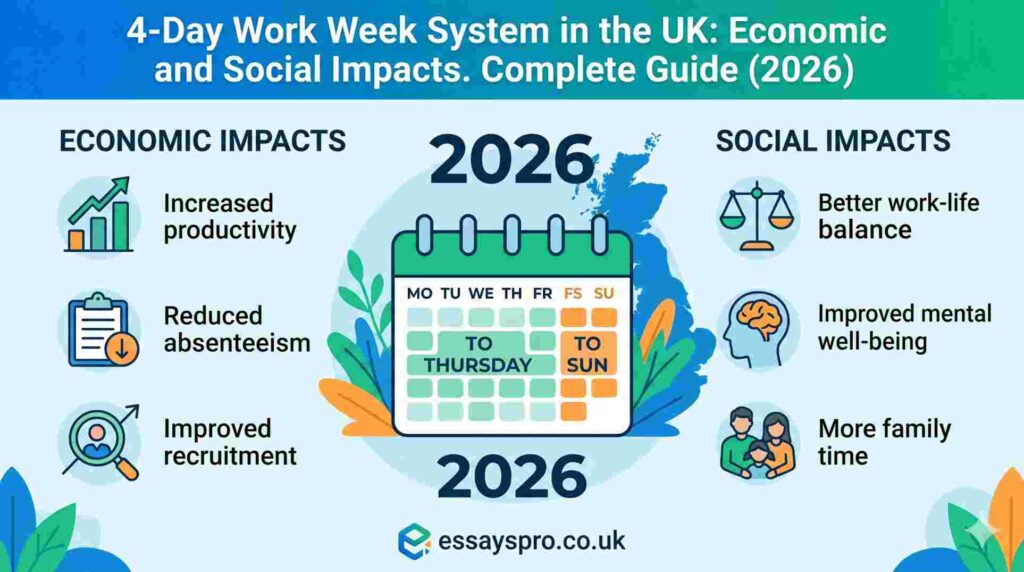
4-Day Work Week System in the UK: Economic and Social Impacts. Complete Guide (2026)
If you are interested in knowing whether the 4-day workweek system has been implemented in the UK and what its social and economic impacts are, and if you need help with business essays, then this blog is for you.
Introduction: How are working and daily life balanced and what impact is it having on the UK economy?
Regarding the balance of work and life and the well-being of employees, both businessmen and policymakers are seriously thinking about how to maintain a balance between work and life. 5 days’ work system was in use in UK for a long time, now recently researchers have suggested 4 days’ work week system in their pilot programs, they have said that by implementing this system, the efficiency of work among employees can be increased and employee satisfaction can also be improved. 4 day work week system basically means that employees can work for 4 days instead of 5 days but by adjusting the total weekly hours a little, their ability to complete the task as per their wish can be improved, due to which time and money will be saved and the productivity and satisfaction of the employees will also improve. Implementing this system benefits not only employees but also businesses. This system generally uses the formula of 100% pay, 80% time, and 100% productivity, which we will see in detail in the next topic.
In this blog, I will tell you in detail where the 4-day workweek system has been implemented in the UK and where it has not yet been implemented. And why implementing this system has been beneficial to businesses and employees. If you are struggling to write UK businesses essay or UK economic growth essay, then hire professional writers like EssaysPro.uk, for their full guidance and assignment helpful.
Complete Detail of the 4-Day Workweek System
The 4-day workweek system has quickly become popular in the UK, and many benefits have been seen. The primary purpose of implementing this concept is to improve the well-being of employees. This 4-day workweek system has also been implemented in New Zealand and Iceland, and its implementation has seen significant benefits for both employees and businesses. This system has not been completely implemented in UK yet, like most of the companies have adopted this system, approximately more than 200 companies have implemented it permanently and in trails more than 90% of the businesses are using it. Actually this system is seen to be implemented in most of the big companies like marketing, tech, finance and it has been successfully implemented in some public sector councils also, like for small companies this system has not been very effective because some factories cannot be closed, they have to give 7 days’ time in a week where this has been demanded by increasing the working hours.
- In which companies has this been implemented and when are there chances of it being fully implemented?
By June 2022, 60+ companies had adopted the 4-day workweek system, with over 3,000 workers, and all of them were happy with it. If I may tell you now, approximately 200+ companies have permanently adopted the system, including companies like Seatfrog, Civo, Form3, Stora, and Simprint. South Cambridgeshire District, a public sector company, was the first to permanently implement this system. This system has not yet been implemented completely in the UK and when will it be implemented, nothing can be said about it yet because no government law has been made, like this system is quite trending in the UK, which was 50% in 2019, now gradually in 2-3 years more than 90% of the businesses have implemented it.
- What benefits did businesses get?
Businesses have benefited greatly from this 4-day work week system. Productivity has increased by approximately 90%. More companies have increased their production due to which this system is also cost saving because this system improves the well-being of employees and they do not lose their jobs, meaning staff turnover has also reduced. And in some companies, sales have increased by up to 35%.
- What benefits did the employees get?
The employees have benefited a lot from this system. The purpose of making this system was that the employees should benefit from this system and their operational work load should be reduced and they could get more days of rest. If you take more rest, the efficiency of working will also increase and you will work more efficiently and with focus. Stress will also reduce. By implementing this system, absenteeism has reduced and up to 65% reduction has been seen in sick leaves.
Analysis of Economic Impacts:
The biggest concern of the businessmen was that by implementing this 4 day work week they should not suffer any loss economically. According to traditional theory, most of the people think that if they work less than the result will not be good, the more time they take to work then the better the result will be. Modern research and pilot programs have shown that when working hours are expanded then productivity also increases and employees work with more focus and remain motivated.
According to the report of UK’s Office of National Statistics in 2025, if the work schedule is flexible then it increases the well-being of the employees and the growth of productivity also increases. According to their report, this 4-days work week system is a best strategy for employees and businesses. To run any work, first of all these investments are required so, that the process can run. Investments have to be made in purchasing digital tools, and staff training. In the long term, employees stay in the company for a longer period and leave is also taken to a minimum, due to which expenses are also reduced. This has a good impact on the economic growth of the UK.
Social and Mental Health Benefits
The four-day workweek system has had significant benefits on social and mental health.
- Mental Benefits:
Employees get more personal time and free their mind for other activities, workload is reduced, and this improves their mental health. According to mental health experts, a shorter work week reduces depression and anxiety rates and increases employee satisfaction.
- Social Benefits:
Apart from mental health, it has many benefits socially too. If employees are free for one day, they will get time to participate in education and community activities. They can also do volunteer work on this off day, thus increasing the scope of participating in social activities. I believe that the more social we are, the more our awareness increases and the growth of productivity also increases. The UK Government and NGOs have highlighted this data and said, that flexible working policies have led to significant improvements in the National Well-Being Index.
Challenges and Concerns
While the 4-day workweek system has its benefits, it also has several challenges, which I’d like to share with you.
- First Challenge:
The primary concern is the operational community, meaning certain sectors where employees are required to work continuously, such as manufacturing or healthcare departments. If employees in these departments work 4 days a week, it can create difficulties in scheduling and resource planning.
- Second Challenge:
The second problem is cost and productivity. Some start-ups and small companies don’t have the money to invest; their primary focus is on maximizing production at a lower cost. For this reason, try working seven days a week. Not every business can easily implement a 4-day work system, which is difficult for small companies. Some businesses rely on flexible scheduling.
- Third Challenge:
The third challenge is of cultural mind-set. It is very difficult to change old thinking and traditional views. In their view, the more time we devote to any work, the better the results we get, and those more working hours are considered a symbol of productivity. To change this mind-set, leadership training and awareness campaigns are needed, which can change the thinking of people.
Case Study: 4-Day Work Week System in UK Tech Firms
Some UK tech companies have implemented 4-days work week system in their companies due to which they have got very good results, this data has been reported. In a very famous case study, a firm with 250 employees implemented 5-days work week to 4-day work week system for 6 months, and they got very good results. There was an increase in employees’ productivity and there were improvements in their mental well-being also. Job satisfaction increased by 25% and employees also reduced sick leaves which saw a reduction of 40%.
Company managers have given feedback that if we implement a 4-day work week system in the short term, adjustments and coordination are required, but if implemented in the long term, there are significant improvements in employee retention. These case studies prove that the operational challenges of a 4-day work week system can be managed and the results are also very good.
Review of its Potential Impact on the UK Economy
The UK economy is expanding in many areas, such as the financial services, technology, healthcare, and manufacturing sectors. Each one has a different problem and method of working. In which sector does this system work and in which does it not? For this, different methods are implemented in all sectors. It is easy to measure its results in the knowledge-based tech sector, but it is quite difficult to implement it in manufacturing and healthcare and then measure its results. If we predict the outcome of UK economy, it is clear that if 4-days work week system is implemented in UK, initially GDP growth will be low which will be difficult to adjust, but then with time passing productivity growth will gradually increase which will be beneficial overall. Policy makers should make separate rules for each sector and launch pilot programs so that this 4-days work week system can be easily implemented and made beneficial for all.
Developing Trends in the Future
This 4-day work week system has become a very trending topic in 2026 and it is expected that this 4-day work week system will spread across the whole UK in the coming days. By introducing flexible working days and increasing working hours, this system can prove to be very beneficial for both the long term and short term, which will increase productivity growth. The government and trade unions are planning to actively regulate and standardize this 4 day work week system, the chances of this system being implemented in the whole UK in the future have become very high.
Recommendations for Policy Makers
Policymakers should first provide sector-wise facilities to implement a four-day workweek system. It is crucial to first understand the needs of each sector. Then, small companies should be supported by developing support programs and guidance frameworks. Awareness campaigns should be run in which people should be told in detail whether it will be beneficial to implement this system and cultural shift campaigns should also be launched so that the mind-set of the employees can be changed. They should be told that adopting digital tools and flexible scheduling will increase productivity. Pilot programs and continuous monitoring should be done because we can implement this system in the whole UK which increases the well-being of the employees and by implementing this system, economic and social benefits can be maximized.
Conclusion
4-days work week system has been proven to improve the well-being of employees in UK. Implementing this system also increases productivity. This is a new and progressive system where employees are getting a chance to take out time for personal life due to which the work load of the employees will also reduce and depression and anxiety will also not occur. Only when the employees have good mental health, they will be able to work with more focus. Companies which have adopted this 4-days work week system have got very good results. There has been a 40% reduction in sick leaves and a 25% increase in job satisfaction. For this, the following formula is used for this 4-days work week system: 100% pay, 80% time and 100% productivity. This means that employees get full salary and work load is reduced by 20%, but still the result is 100%. In the short term, businesses will have to face economic adjustments but in the long term, socio-economic and mental well-being benefits are achieved. This 4-week work week system is gradually expanding in the UK which is also yielding very good results.
Written By: Sidra Gillani🦋